
Last updated November 2, 2026
 Wrought iron
 Wood & steel frame
 Farm & ranch
 Sliding driveway gates
 LiftMaster operators
Free on-site gate assessment - hinges, posts, and your LiftMaster or Nice gate operator checked before anything is quoted
The assessment is free and the quote is the invoice.
Get your free estimateGate Repair Warning Signs: A Whittier Homeowner’s Reference Guide
Here’s a counterintuitive fact: most gate failures in Whittier announce themselves weeks before they happen. A gate that hesitates for half a second before moving, or one that makes a sound you can’t quite place, isn’t just being temperamental. It’s reporting. The problem is that most homeowners don’t speak the language. This guide teaches you to read your gate’s behavior as diagnostic data instead of annoyance. By the end, you’ll know which warning signs mean “schedule a service call this week” and which mean “call someone today before the gate fails completely and leaves your driveway blocked.”
Quick Answer
Gate repair warning signs in Whittier fall into three categories: automation faults (reversing mid-cycle, grinding motors, blinking sensor lights), structural strain (sagging, scraping, leaning posts), and electrical failures (dead keypads, intermittent power, tripped breakers). The most urgent signs are mid-cycle reversals caused by misaligned safety sensors and metallic grinding from a failing motor gear. Both typically require same-day attention before the gate becomes inoperable and blocks vehicle access; contact our Gate Repair services if you notice these symptoms.
Styles & brands we work with
- Wrought iron
- Wood & steel frame
- Farm & ranch
- Sliding driveway gates
- LiftMaster operators
Table of Contents
- The Symptom-to-Cause Reference Table: What Your Gate Is Telling You
- Swing Gates vs. Slide Gates: Different Failure Signatures
- Automation Warning Signs vs. Structural Warning Signs: How to Tell Them Apart
- Same-Day Urgency vs. Scheduled Repair: A Decision Framework
- How to Safely Observe and Document Warning Signs
- Whittier-Specific Warning Signs: Climate, Soil, and Local Factors
- Brand-Specific Warning Signs: BFT, Linear, Viking, and Ghost Controls
- The Real Cost of Ignoring Warning Signs in Whittier
The Symptom-to-Cause Reference Table: What Your Gate Is Telling You
A gate that reverses direction without obstruction isn’t malfunctioning randomly. It’s reporting that a safety sensor is misaligned or the limit switch has drifted. It will keep “failing randomly” until someone addresses the actual fault. This is the core principle behind diagnostic gate reading: every symptom maps to a component. Here’s the reference table we use on service calls across Whittier every week.
| Symptom | Most Likely Cause | Component Involved | Urgency |
|---|---|---|---|
| Gate reverses mid-cycle without obstruction | Misaligned photo eye or drifted limit switch | Safety sensor / limit switch | High – same-day |
| Slow opening speed (slower than normal) | Worn capacitor, low voltage, or failing motor bearing | Motor / capacitor / power supply | Medium – schedule within a week |
| Metallic grinding during operation | Stripped gear or failing bearing in operator | Operator gearbox | High – same-day |
| Gate stops halfway and won’t continue | Obstruction in track (slide) or hinge binding (swing) | Track / hinges / limit switch | Medium – schedule within a week |
| Sensor light blinking continuously | Photo eye misalignment or wiring fault | Safety sensor | High – same-day |
| Gate closes but won’t open | Failed capacitor, control board fault, or dead remote battery | Control board / capacitor / remote | High – same-day |
| Humming sound but no movement | Failed start capacitor or seized motor | Motor / capacitor | High – same-day |
| Gate sags visibly and scrapes the ground | Worn hinge bearings or shifted post | Hinges / post footing | Medium – schedule within two weeks |
| Keypad works intermittently | Corroded wiring or failing keypad membrane | Keypad / low-voltage wiring | Medium – schedule within a week |
| Gate slams at end of travel | Failed limit switch or missing stop | Limit switch | High – same-day |
One thing worth noting from this table: the highest-urgency items are almost always sensor or limit-switch related. That’s because those components govern safety, not just convenience. When a limit switch fails, the gate doesn’t know where to stop. When a photo eye misaligns, the gate reverses because it thinks something is in the way. Both conditions will eventually leave your gate stuck in whatever position it was in when the component gave out entirely.
We’ve seen this pattern hundreds of times across Whittier: a homeowner notices the gate acting “a little weird” for two or three weeks, then calls us when it stops working entirely on a morning they needed to leave for work. Reading the table above and acting on the early warning prevents that scenario. For a deeper look at how these symptoms play out in practice, see our Gate Repair in Whittier page.
Swing Gates vs. Slide Gates: Different Failure Signatures
Swing gates and slide gates fail differently because they carry load differently. A swing gate’s weight hangs on its hinges and post. A slide gate’s weight rides on wheels along a track. That fundamental difference means the warning signs are different, and diagnosing them requires understanding which failure mode applies to your gate type.
Swing Gate Warning Signs
Swing gates in Whittier, especially the ornamental steel ones common in neighborhoods like Friendly Hills and Michigan Park, tend to fail at the hinges first. Here’s what to watch for:
- Visible sag at the latch side: Stand at the hinge post and sight down the gate. If the latch-side corner sits lower than the hinge-side corner by more than half an inch, the hinge bearings are wearing or the post is shifting in its footing.
- Scraping at the latch-side bottom: This is the same problem as sag, but audible. If you see fresh scrape marks on the driveway concrete near the latch, the gate is dragging. It will only get worse as the post continues to shift.
- The gate “jumps” when it starts moving: This is usually a hinge binding against a worn bushing. The motor has to overcome the bind, which spikes current draw and shortens operator life.
- The gate won’t close the last few inches: Often a limit switch issue, but on swing gates it can also mean the hinge side has shifted enough that the gate geometry changed. The operator thinks the gate is closed when it isn’t.
Swing gate failures are often structural first and automation second. The operator is trying to move a gate that has become harder to move, and it burns out prematurely as a result. Addressing hinge and post issues early extends operator life significantly.
Slide Gate Warning Signs
Slide gates carry their weight on wheels, which means their failure signatures live in the track, the wheels, and the chain or belt drive. Whittier’s dry climate means less corrosion than coastal areas, but dust and debris from the nearby hills still accumulate in tracks and accelerate wheel wear.
- Rough, jerky movement along the track: This indicates worn wheel bearings or debris in the track. A slide gate should move with one smooth motion. Any jerkiness means something is resisting.
- A rhythmic “thump” as the gate travels: This is a flat spot on a wheel or a bent track section. You’ll hear it at consistent intervals because the gate hits the same spot every pass.
- The gate slows down near the end of travel: On a slide gate, this often means the chain or belt is stretched and losing tension. It’s a sign the drive system needs adjustment before it jumps a tooth and throws the gate out of sync.
- Visible side-to-side wobble while moving: The guide rollers at the top or bottom are worn or loose. Left unaddressed, the gate can derail from its track entirely.
For slide gates, automation failures and mechanical failures are more intertwined than on swing gates. A gate that’s fighting its own track will overwork the motor, blow capacitors, and strip gears. That’s why Electric Gate Repair in Whittier starts with the mechanical condition before touching electronics – you can’t diagnose a control board accurately if the gate itself doesn’t roll freely.
Automation Warning Signs vs. Structural Warning Signs: How to Tell Them Apart
Here’s the diagnostic challenge: both automation faults and structural problems can look like “the gate is acting weird.” A gate that moves slowly could have a failing capacitor (automation) or a binding hinge (structural). A gate that reverses could have a misaligned sensor (automation) or a warped gate frame catching on the latch post (structural). Telling them apart requires looking at the right signals.
Signs That Point to Automation
- The problem is intermittent and not tied to weather or time of day: A failing control board often behaves inconsistently. One cycle the gate works fine, the next it doesn’t. If there’s no pattern, think electronics.
- The remote or keypad is involved: If the gate only misbehaves when you use the remote but works fine from the keypad (or vice versa), the problem is in the access-control side, not the gate itself.
- The operator makes noise but the gate doesn’t move: A humming sound with no movement is almost always an electrical or electronic fault: a seized capacitor, a failed motor winding, or a control board not sending the right signal.
- Sensor lights are blinking in an unusual pattern: Every operator brand has a diagnostic blink code for its photo eyes and control board. If the light pattern changed, the system is telling you something specific.
Signs That Point to Structure
- The problem is consistent and repeatable: A gate that scrapes every single time it opens is a structural problem. Mechanical failures are predictable. Electronic failures are often erratic.
- You can see the problem with your eyes: Sag, visible gaps at the hinges, a post that’s no longer plumb, fresh scrape marks on concrete – these are structural signs you can confirm visually without any tools.
- The gate feels different when you push it manually: If you release the operator (using the manufacturer’s manual release) and the gate is hard to push, the resistance is mechanical. If it pushes easily but won’t operate under power, the problem is electrical.
- Weather made it worse: Whittier’s occasional heavy rain can shift posts set in expansive soil. If the gate started misbehaving right after a storm, check for structural movement before blaming the operator.
The distinction matters because the fix is different. Replacing a control board won’t fix a shifted post. Tightening a hinge won’t fix a failed capacitor. And in many cases we see, both have failed: a structural problem created extra load that burned out an automation component. That’s why a proper diagnostic looks at the whole system, not just the part that’s obviously broken.
Same-Day Urgency vs. Scheduled Repair: A Decision Framework
Not every warning sign requires a same-day call. But some do, and misreading the urgency can cost you an emergency dispatch rate when the gate fails completely at the worst possible time. Here’s the framework we recommend for Whittier homeowners.
Call for same-day or next-day service when:
- The gate reverses mid-cycle without obstruction. This means the safety sensors or limit switch are actively failing. The gate may work sometimes and not others. More importantly, a gate that reverses unpredictably is a safety hazard to people and vehicles in its path.
- You hear metallic grinding from the operator. Grinding means something inside the gearbox is eating itself. The longer it runs, the more expensive the repair. A stripped gear can be replaced. A shredded gearbox housing often means a new operator.
- The gate slams at the end of travel. A failed limit switch means the gate no longer knows where to stop. That’s a safety risk and a damage risk to the operator itself.
- The gate won’t open at all and your vehicle is behind it. This one is self-evident, but it’s worth stating: a gate that’s closed and won’t open is a vehicle access problem, not just an inconvenience. This is when gate installation shoppers also call us, realizing their old system has reached end of life.
Schedule a standard service call when:
- The gate is slower than normal but still operates consistently. This is usually a worn capacitor or bearing that will hold for a few more weeks. A scheduled repair costs less than an emergency call and catches the problem before it cascades.
- You see visible sag but the gate still operates without scraping. Hinge and post issues worsen gradually. A repair within two weeks prevents the sag from becoming a scrape, which prevents the scrape from becoming an operator burn-out.
- The keypad works intermittently. This is usually a wiring or membrane issue that won’t leave you locked out immediately, but will eventually fail completely. Schedule it before it does.
- Fresh scrape marks are shallow and recent. You have a window of time before the drag translates into operator strain. Use it.
The rule of thumb: anything involving safety sensors, limit switches, or grinding metal is urgent. Anything involving gradual wear, intermittent keypads, or early-stage sag can be scheduled. When in doubt, call for a diagnostic. Reading a warning sign wrong is cheaper to fix than a gate that failed at 7 a.m. on your way to work.
How to Safely Observe and Document Warning Signs
Before you call for service, you can gather diagnostic information that will speed up the repair and reduce the total cost. But there’s an important safety boundary here: you observe and document. You do not defeat, bypass, or adjust safety components. Photo eyes exist to prevent a gate from closing on a person, pet, or vehicle. A gate that reverses because the sensor is misaligned is a gate doing its job, even if it’s inconvenient.
Here’s a safe process for documenting what your gate is doing:
- Stand clear of the gate’s travel path and operate it through a full open-close cycle. Watch the movement. Is it smooth or jerky? Does it slow down anywhere? Does it reverse? Take note of exactly where in the cycle any problem occurs.
- Listen for sounds and note when they happen. A grinding sound that happens only at the start of movement points to a different component than one that happens at the end of travel. Write down what you hear and when.
- Look at the sensor lights. Most photo eyes have a small LED that shows alignment status. A solid light usually means aligned. A blinking or off light usually means a problem. Note the color and behavior. Do not touch or adjust the sensor – just note what you see.
- Check for visible structural changes. Walk to the hinge side and sight down the gate. Check for fresh scrape marks. Look at the posts to see if they’re still plumb. Use your phone camera to photograph anything that looks off.
- Test the gate manually only if you know how to release the operator safely. Most operators have a manual release handle. If you’re not comfortable using it, skip this step entirely. The goal is information, not a home repair.
When you call a gate repair service, this documentation helps the technician arrive with the right parts and a clear diagnostic plan. It also helps you avoid paying for diagnostic time that could have been shortened by a good description. A homeowner who says “the gate reverses about four feet from the close position and I heard a grinding sound at the start of travel” gives us more to work with than one who says “the gate is broken.”
Whittier-Specific Warning Signs: Climate, Soil, and Local Factors
Whittier’s specific geography and climate create gate problems that homeowners in other cities don’t see as often. Understanding these local factors helps you anticipate issues before they become emergencies.
Expansive Soil and Post Movement
Whittier sits on soil with a significant clay content in many areas, particularly in the hillside neighborhoods above Hadley Street and along the Greenway Trail corridor. Clay soil expands when wet and contracts when dry. After Whittier’s winter rains, posts set in clay soil can shift measurably. The gate that worked perfectly in October scrapes the ground in February. The failure signature is seasonal: gate performance degrades after rain, improves as the soil dries, then degrades again next year. For prevention tips, see our Seasonal Gate Repair Care for Whittier: Year-Round Homeowner’s Guide. If you notice this pattern, the fix is a post reset with proper concrete footing, not repeated hinge adjustments.
Santa Ana Wind Load
Whittier catches significant Santa Ana wind events, especially in the fall. A solid-panel swing gate acts like a sail in a 40-mph gust. Operators that are sized for the gate’s weight but not its wind load will struggle in those conditions. Warning signs include: the gate moving slower than normal on windy days, the operator making laboring sounds when fighting gusts, and the gate reversing because wind resistance tripped the obstruction detection. If your gate misbehaves primarily during Santa Ana events, tell the technician. It may mean the operator is undersized for the gate’s wind exposure.
Dust and Debris from the Puente Hills
Homes in the northern and eastern parts of Whittier, closer to the Puente Hills, deal with dust accumulation that coastal homeowners don’t. That dust settles into slide gate tracks, mixes with chain lubricant to form a grinding paste, and coats photo eye lenses until they can’t maintain alignment. A slide gate that moves roughly after a dry, windy stretch is often fighting debris in its track. A photo eye that keeps misaligning may simply have a dirty lens. These are quick fixes but recurring maintenance items in this part of Whittier.
Copper Wiring and Rodent Damage
Whittier’s mature neighborhoods have trees, and trees mean squirrels and rats. Rodents chew low-voltage wiring, especially the small-gauge wires running to keypads, photo eyes, and vehicle loop detectors. Intermittent keypad failures or sensors that work sometimes and not others are often rodent damage that’s hard to see without opening junction boxes. If you’ve had rodent issues elsewhere on your property, add this to your differential diagnosis when the gate starts acting strangely.
The practical takeaway: knowing which of these Whittier-specific factors apply to your property helps you describe the problem more accurately and helps the technician look in the right place first. For more on how local conditions affect repair work, see the Capitol Gate Repair home page.
Brand-Specific Warning Signs: BFT, Linear, Viking, and Ghost Controls
Our technicians service nine major gate operator brands, including BFT, Linear, Viking, and Ghost Controls. Each brand has characteristic failure modes that experienced technicians recognize quickly. If your gate runs one of these operators, here’s what to watch for.
BFT Systems
BFT is an Italian brand common on residential swing gates in Whittier’s higher-end neighborhoods. BFT operators are generally reliable, but their control boards are sensitive to power surges. A BFT gate that resets to factory defaults after a power outage, or one that lost its remote programming for no apparent reason, is often showing early control-board distress. The warning sign is “the gate forgot my remotes” or “the gate opens but the close limit is wrong now.” These are board issues that need attention before the board fails completely. BFT parts can have longer lead times than domestic brands, so addressing early warning signs before a complete failure saves you downtime.
Linear Systems
Linear is an American brand, extremely common in Whittier because it’s been spec’d by builders for decades. Linear operators are workhorses, but their capacitors are a known wear item. A Linear gate that hums but doesn’t move, or one that starts slowly and then catches, is showing classic capacitor failure. The good news: capacitors are relatively inexpensive to replace. The bad news: running a Linear operator with a failing capacitor burns out the motor over time. If your Linear gate is slow to start, replace the capacitor now, not after the motor seizes.
Viking Systems
Viking specializes in slide gate operators and is common on Whittier properties with driveway gates, especially in the commercial and light-industrial areas along Whittier Boulevard. Viking operators are built for heavy use, but their chain-drive systems require tension adjustment. A Viking gate that jerks on startup or makes a slapping sound as it travels is often showing chain-stretch. Left unaddressed, the chain can jump a sprocket tooth and throw the gate out of timing. This is a maintenance item, not a repair, and it’s one we handle routinely.
Ghost Controls Systems
Ghost Controls is a newer brand popular with DIY installers. We see Ghost Controls systems on Whittier gates that homeowners installed themselves or had installed by a handyman. The most common warning sign on Ghost Controls systems is a gate that opens fine but struggles to close, or one that reverses constantly during closing. This often traces back to a limit-setting problem from the original installation, not a component failure. The good news is these are usually programmable fixes. The bad news is that repeated reversing is hard on the operator’s gear train, so it’s worth correcting early.
If your operator is one of these brands, mention it when you call for service. Our technicians arrive already familiar with the brand’s quirks, which means faster diagnosis and more accurate parts sourcing. That’s the whole point of specializing in gates instead of being a general contractor who occasionally touches one.
The Real Cost of Ignoring Warning Signs in Whittier
Every warning sign has a cost, and the cost of addressing it early is almost always lower than the cost of ignoring it. Here’s what we see in Whittier, in real dollar terms.
A failing capacitor: Replace it for $120 – $180 during a scheduled visit. Ignore it for six weeks and the motor burns out, which means a $400 – $700 motor replacement. The warning sign was there the whole time.
A sagging gate: Replace hinge bearings and adjust the gate for $250 – $450 before it scrapes. Ignore it for three months and the operator overheats fighting the additional friction, which means a $600 – $1,200 operator replacement on top of the hinge work. The physics compounds against you.
A misaligned photo eye: Realign it during a routine call for $90 – $150. Ignore it and the repeated mid-cycle reversals put stress on the entire drive train. At minimum you’ll deal with weeks of aggravation. At worst you’ll replace components that failed because the gate kept reversing under load.
A grinding gear: Replace the gear for $180 – $300 when the grinding starts. Ignore it for two weeks and metal shavings contaminate the gearbox, which means the entire operator needs replacement at $800 – $1,800 depending on the brand and model.
The pattern is consistent: early intervention costs a fraction of failure-driven repair. And that’s before you account for the cost of being locked in or out of your driveway on a morning you needed to leave. For a full picture of what gate repair services include, see our Gate Repair in Whittier page.
Common Mistakes to Avoid
- Ignoring intermittent behavior because “it still works.” An intermittent fault is a failure in progress. The gate that works every other time will eventually stop working entirely, and it always seems to choose the worst morning to do it in Whittier.
- Adjusting safety sensors yourself to stop the reversing. The reversing is the symptom, not the problem. Misaligning a photo eye to force the gate closed defeats a safety device and creates a real injury risk for anyone in the gate’s path.
- Lubricating a grinding operator. Grinding means a mechanical failure, not a lubrication need. Adding lubricant to a stripped gear doesn’t un-strip it. It just makes the gearbox messy for the technician who eventually has to open it.
- Waiting until the gate fails completely before calling. This is the most expensive decision a homeowner can make. Emergency dispatch rates, replacement components instead of repairable ones, and the cost of being locked out compound into a much larger bill than a scheduled call would have been.
- Assuming the operator is the problem when the gate is visibly sagging. A sagging gate overworks the operator. Replacing the operator without fixing the structure just means you’ll replace the operator again in two years.
- Not mentioning the brand when calling for service. “My gate is broken” gives the dispatcher nothing to work with. “My BFT swing gate reverses about two feet from close and I heard a grinding sound this morning” tells us which tech to send and which parts to load.
- Repeatedly pressing the remote or keypad when the gate doesn’t respond. Each command cycle stresses the motor and control board. If the gate didn’t respond the first time, pressing the button ten more times isn’t fixing anything and may be cooking the capacitor.
See the difference
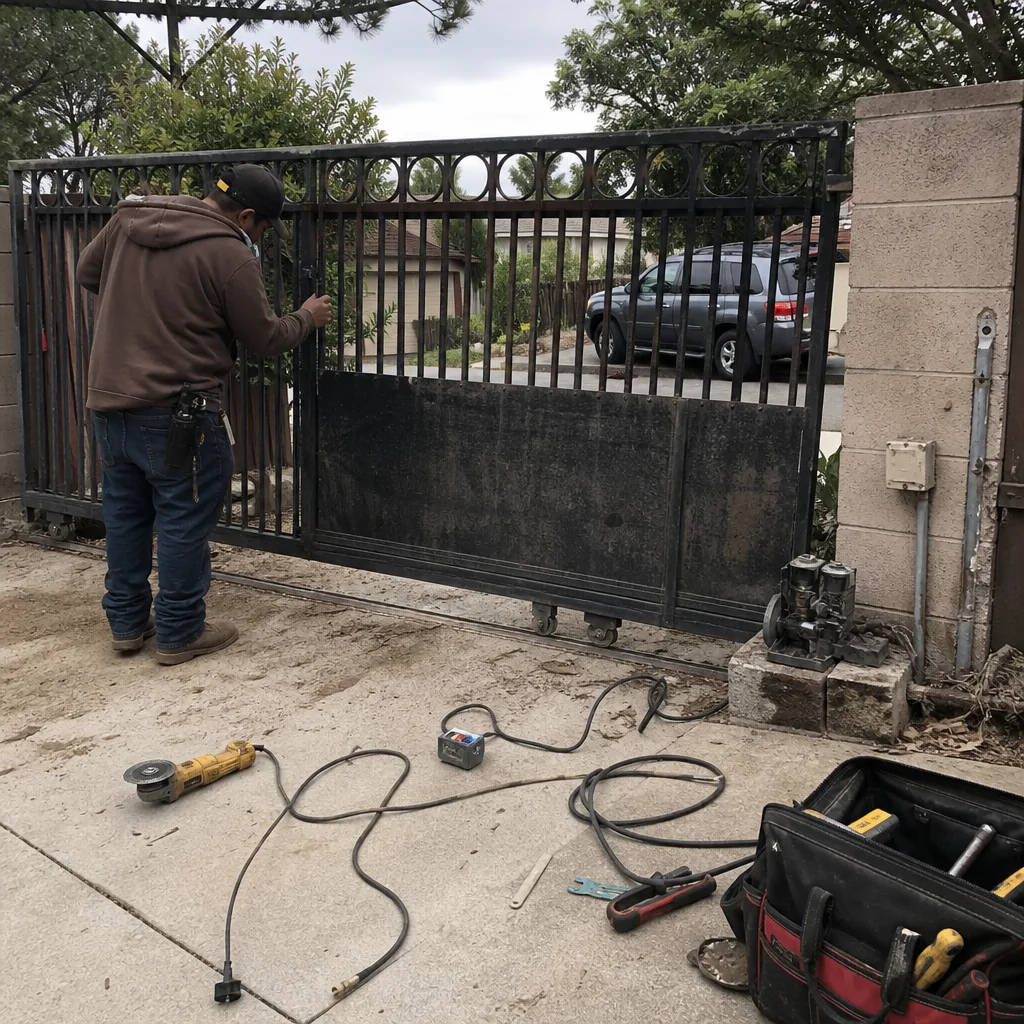 Before
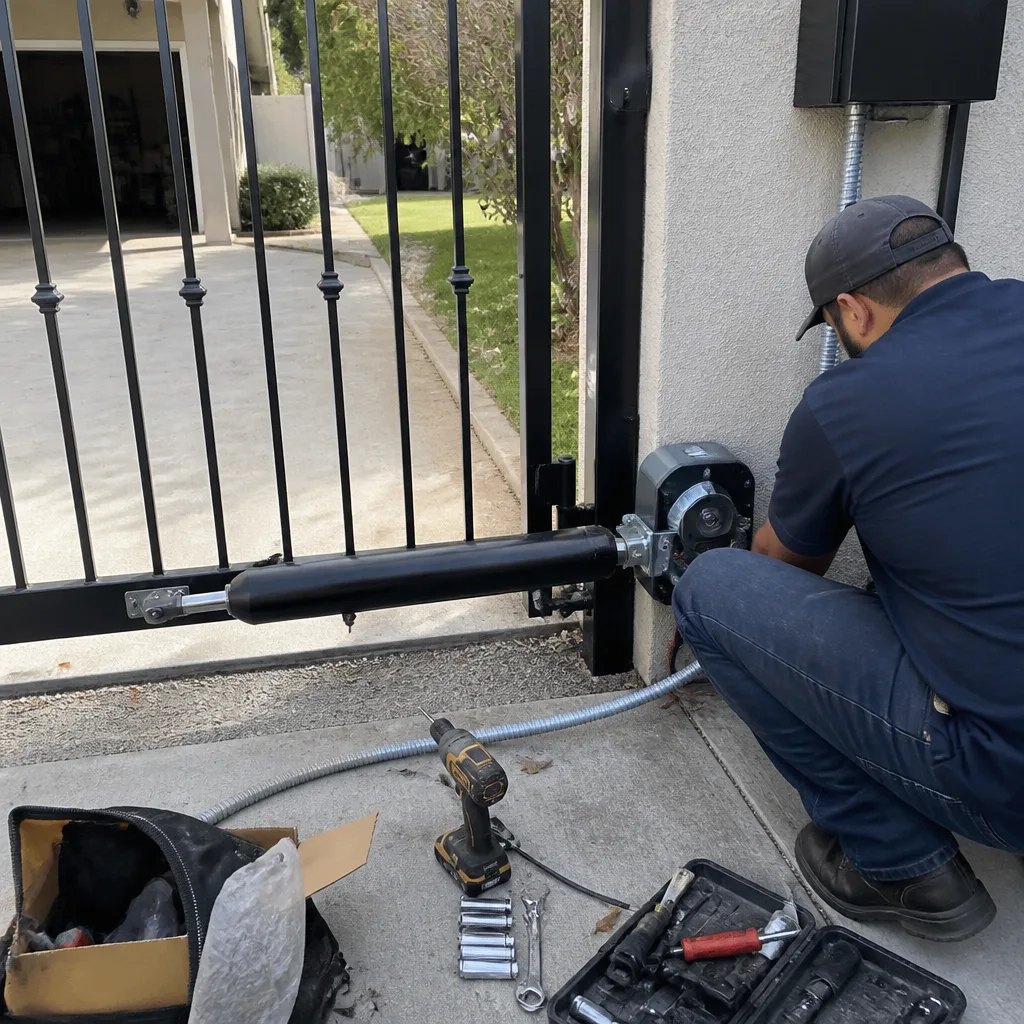 After
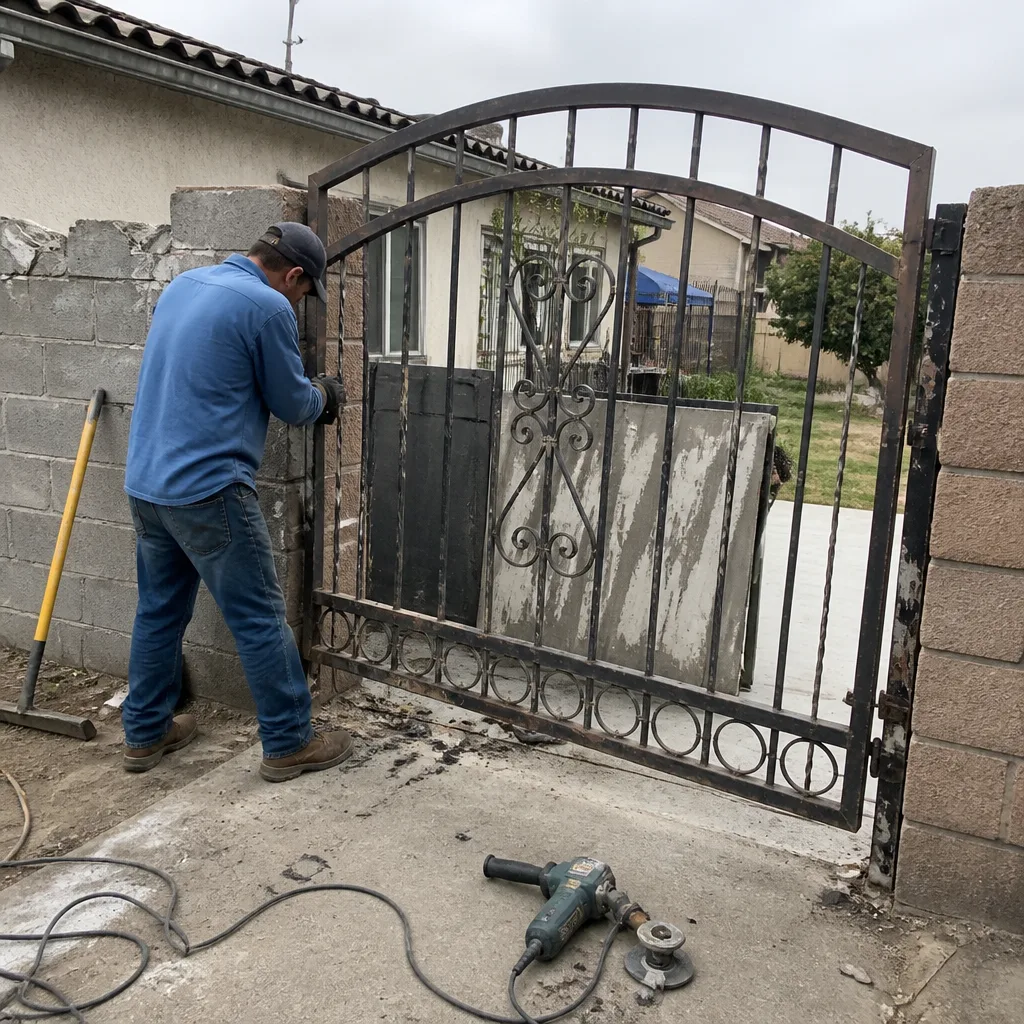 Before
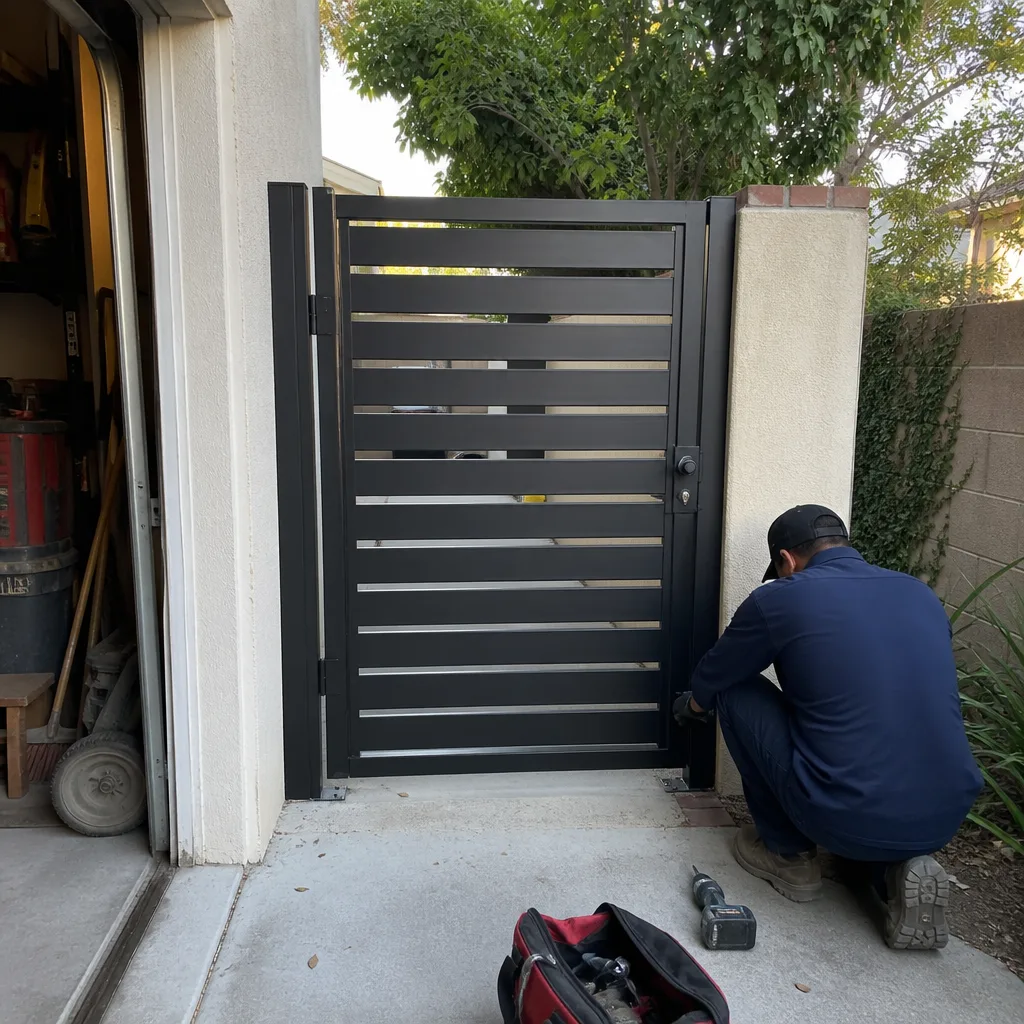 After
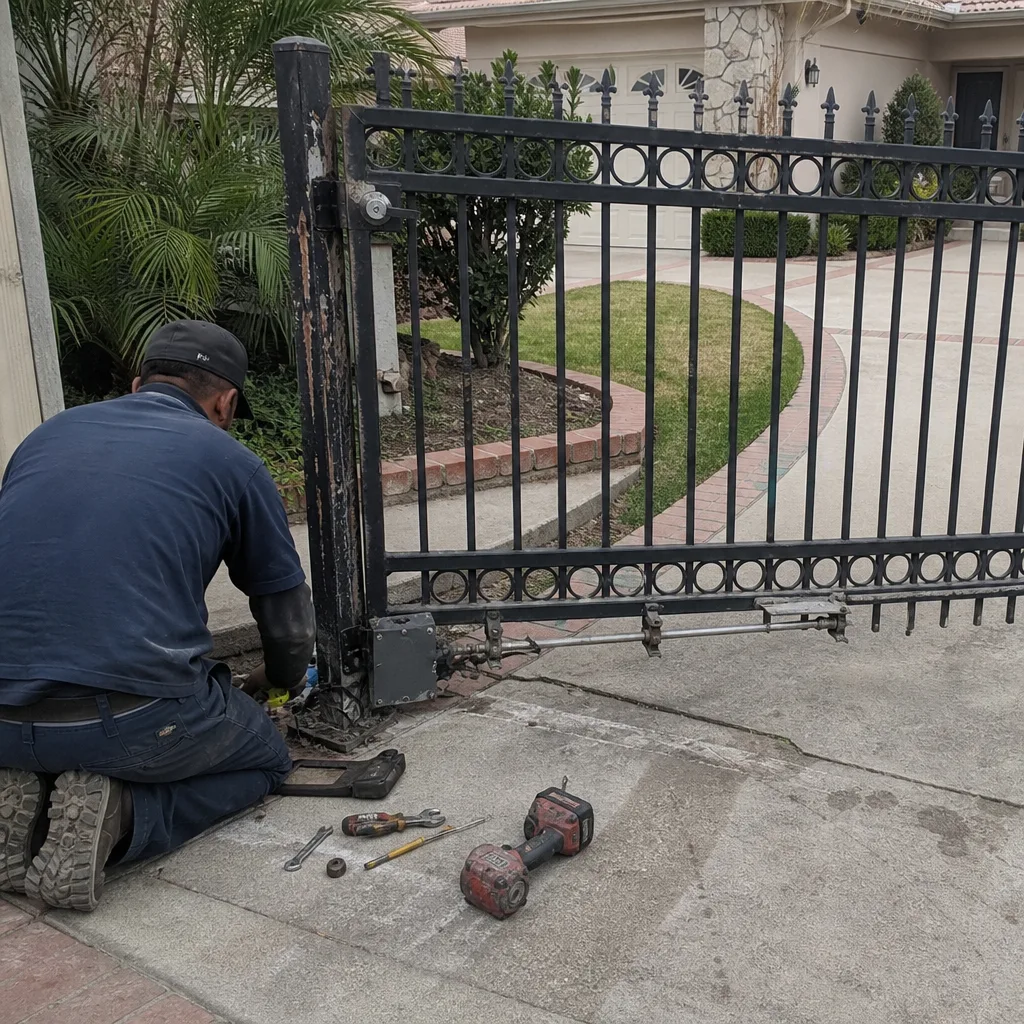 Before
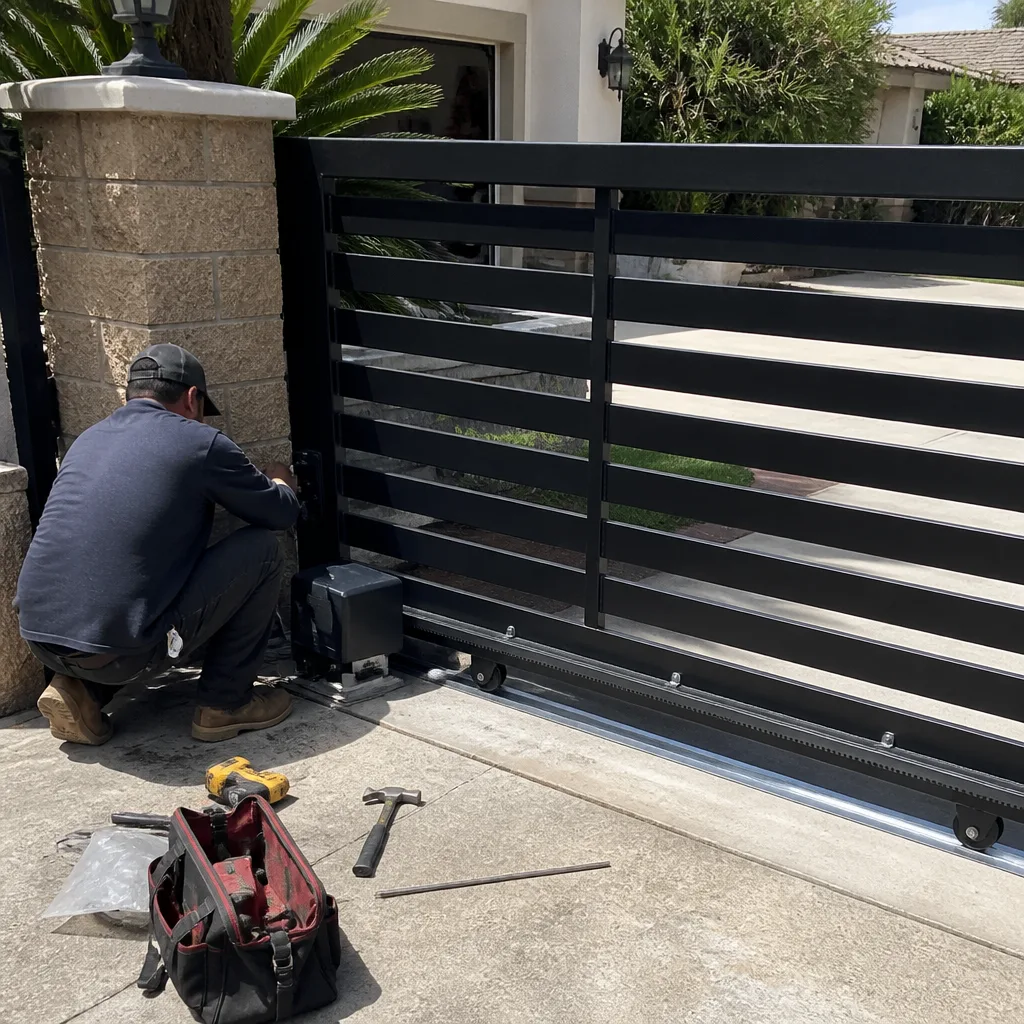 After
When to Call a Professional
Call a professional when the warning sign involves any safety component, any grinding mechanical sound, or any behavior that leaves your gate unpredictable. A gate that might reverse at any moment is a hazard. A gate that might fail closed is a vehicle access problem. A gate that slams at the end of travel is a safety and equipment-damage risk. These are not DIY situations, and they’re not situations where you should wait and watch.
Capitol Gate Repair offers free estimates in Whittier. Call (866) 321-3968 for a diagnostic visit. We work exclusively on gates, which means the technician who shows up at your door works on gate operators, sensors, tracks, and hinges every single day, not as a side job between bathroom remodels.
Frequently Asked Questions
A gate that reverses without obstruction is almost always a misaligned photo eye or a drifted limit switch. The safety system is detecting something that isn’t there, usually because the photo eye lost alignment or the limit setting changed over time. In Whittier, we also see dust on the photo eye lenses as a common culprit, especially in hillside neighborhoods. This is a same-day repair priority. Call (866) 321-3968 for a diagnostic.
Grinding means a mechanical component inside the operator is failing, usually a gear or bearing. The sound is metal touching metal where it shouldn’t. Continuing to run the gate makes the damage worse and spreads metal shavings through the gearbox. This is a stop-using-the-gate situation until a technician can inspect it. We’ve replaced $200 gears and we’ve replaced $1,800 operators. The difference is how long the grinding went on before the call.
Gate repair in Whittier typically runs $150 – $450 for common fixes like sensor realignment, limit switch adjustment, capacitor replacement, and hinge work. More involved repairs like operator replacement or post resetting run higher. The price is quoted and agreed before any work starts, so there’s no surprise invoice at the end. Exact pricing depends on the brand, the fault, and the access situation. Estimates are free.
For urgent issues like mid-cycle reversals, grinding operators, and gates that won’t open, we prioritize same-day and next-day service in Whittier. Scheduled maintenance and non-urgent repairs are booked within a normal service window. When you call, describe the symptom and the brand. That helps us dispatch the right technician with the right parts on the first visit.
Yes, and the sooner the better. A sagging gate adds load to the operator every time it cycles. The operator compensates until it can’t anymore, and then you’re paying for hinge work and an operator replacement. The hinge repair is cheaper than the operator replacement. The math strongly favors addressing sag early.
We service nine major brands: LiftMaster, FAAC, BFT, Linear, Viking, Ghost Controls, DoorKing, Elite, and Mighty Mule. If your operator is one of these, our technicians are already familiar with its failure modes, its parts sourcing, and its programming. Mention your brand when you call and we’ll send the right technician.
The Bottom Line
Your gate talks to you. The slow start, the mid-cycle reversal, the grinding sound, the sag on the hinge side – these are diagnostic signals, not personality quirks. Reading them early means a $150 scheduled repair instead of a $1,200 emergency replacement. Explore more guides & resources to keep your gate running smoothly year-round. Reading them late means getting locked out on a bad morning. Whittier’s specific conditions – expansive soil that shifts posts, Santa Ana winds that strain operators, hillside dust that fouls tracks and sensors – mean your gate is working against real environmental forces. When something changes in how it behaves, pay attention. Then call (866) 321-3968 for a free estimate before the warning sign becomes a failure. We specialize exclusively in gates. That’s all we work on, and it’s all we’ve needed to work on to know exactly what your gate is trying to tell you.
Written by the team at Capitol Gate Repair, serving Whittier since 2013.